
Records of Time
The Vurtgoren Calendar records the passage of time, preserving the order of years and the memory of events. It is governed by the great astronomical divisions of Era and Cycle, upon which the patterns of season and weather across the continent are said to depend.
One Era comprises thirty-two Cycles, or one thousand and twenty-four Years.
One Cycle comprises thirty-two Years, and is divided into four Great Seasons.
One Great Season comprises eight Years.
One Year comprises eight Moons, or three hundred and sixty Days.
One Moon comprises forty-five Days.
The Cycle
The Cycle begins in the midst of the Great Winter. Its turning is marked by the Festival of Darkness, held during the Great Night. With the passing of the fourth year, the Great Spring begins, an event observed across the Union with the Festival of the Great Spring.
At each fourth year thereafter, a festival is held to mark the passage between the Great Seasons, or the height of their course. Below is set a diagram of the Cycle and the eight festivals, traced in the customary course by which its turning is observed.
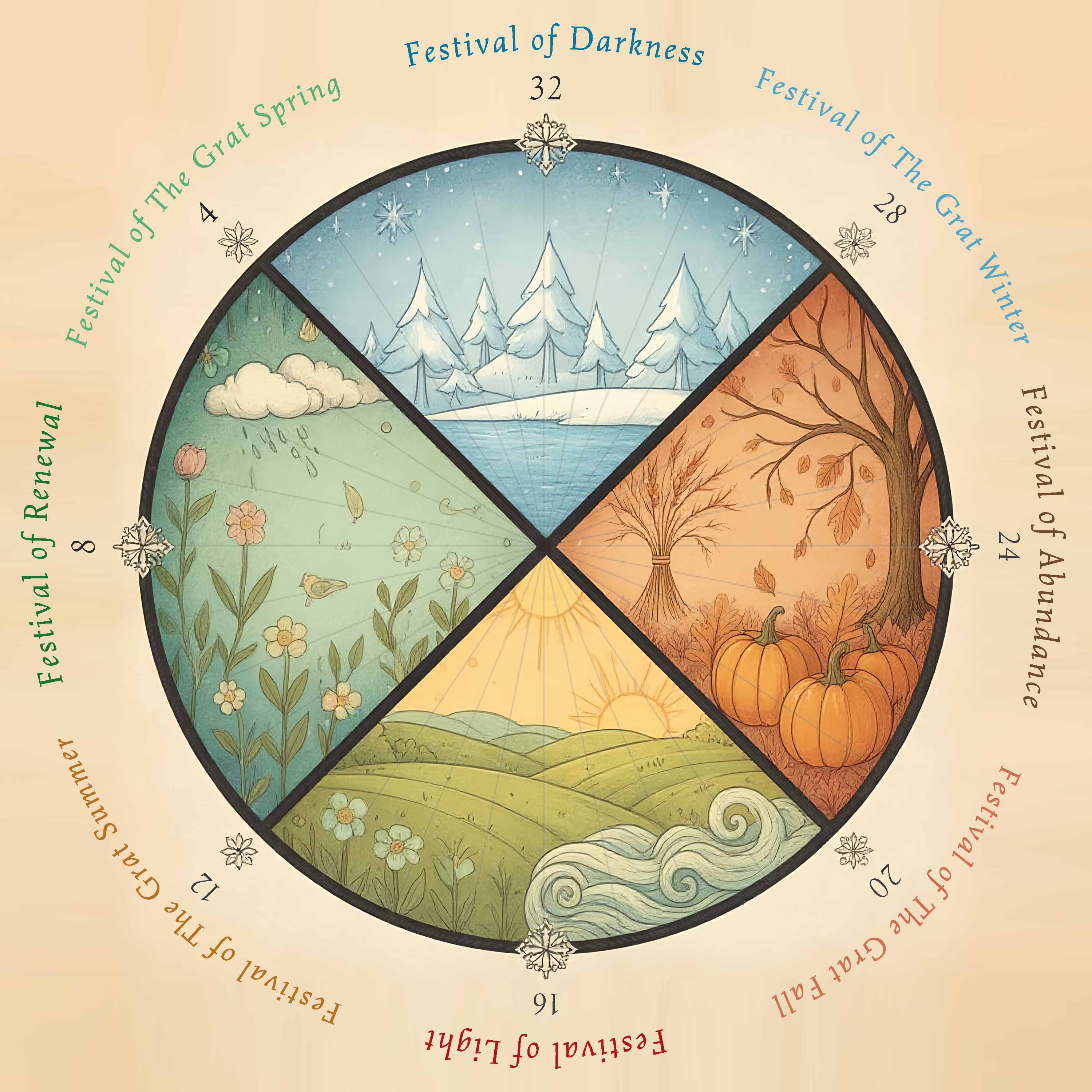
A diagram depicting the cycle.
The Great Seasons
Each of the Great Seasons brings forth its own prevailing character of weather across Vurtgoren. Though the Small Seasons endure throughout the Cycle, their nature is shaped by the greater turning in which they fall.
The Great Winter
The Great Winter is marked by extreme cold and by the division of light and darkness. At its height, half the year lies in unbroken night, while the other half is held in continuous daylight. For this reason, the turning of the Cycle is known as the Great Night, the longest night of all, lasting four moons, at whose midpoint the new Cycle begins.
Only two Small Seasons are known in this time: the Small Winter, which governs the long night, and the Small Summer, which governs the long day.
The Great Spring
The Great Spring brings more temperate conditions, within which the four Small Seasons are distinctly observed. The first and last moons of each year mark the Small Winter; the second and third, the Small Spring; the fourth and fifth, the Small Summer; and the sixth and seventh, the Small Fall.
Within this balance, winters remain harsh and summers warm, while spring and fall are generally mild. The earlier years of the Great Spring tend toward colder conditions, while its latter years grow progressively warmer.
The Great Summer
The Great Summer is marked by sustained warmth throughout the year. Though the Small Seasons persist, their differences are diminished: winters are mild, while summers grow increasingly hot and humid. At its height, the distinction between seasons nearly vanishes, and the climate remains uniformly oppressive.
The Great Fall
The Great Fall bears resemblance to the Great Spring, though in reverse measure. Its earlier years are marked by warmth, while its latter years descend into increasing cold, as the Cycle turns once more toward the Great Winter.
Historical Records
The earliest surviving accounts trace the formation of the Old Empire of Gorendor to a ceremony held during the Great Night between Cycles. This moment is held as the beginning of the First Era.
The time preceding it is known as the Ancient Era, from which few records endure. It is widely held that in its final Cycle, the Urdgoren tribes were united under the First Senedor, culminating in the founding of the Old Empire during the Great Night. In the years that followed, the midpoint of that night came to be known as the Night of Or.
Whether by coincidence or by the will of higher powers, the Old Empire endured for the span of a single Era. What was founded upon the first night of the First Era was brought to its end upon the first night of the Second.
Its fall was preceded by a series of uprisings that began in the final Great Fall of the First Era, a period remembered as the Bloody Fall for its violence and unrest. With the coming of the last Great Winter, these rebellions converged into what is now known as the Great Rebellion. After four years of war, the forces of the Empire were ultimately overcome, and its authority brought to an end.
At the turning of the Era, the nobles of the Old Empire renounced the Senedor and the Old Ways, seeking accord with the rebels and bringing an end to an age long marked by cruelty and unchecked dominion.
In the fourth year of the Second Era, at the Festival of the Great Spring, the Great Union of Vurtgoren was formally established.
Its founding marked the beginning of a more ordered age. Though lesser conflicts have endured across the continent, the Union itself has remained, providing a framework within which peace and stability are largely preserved.
These records are set down in the Seventh Moon of the Twentieth Year, within the Thirty-Second Cycle of the Second Era.